 Jessica Singer
How to Drive Direct Bookings for Vacation Rentals & Boost Margins
When bookings slow down, most operators drop their rates. It feels logical, but it’s actually just a symptom of low demand, not a strategy for...
Airbnb and Vrbo have been busy. Higher fees, new house rules, new terms. If you manage vacation rentals, it can feel like the platforms keep moving the goalposts, and you’re stuck playing a game on their field. The good news? You can beat them at their own game. Airbnb now takes 15.5% of bookings from most hosts, Vrbo moved hosts to a 12% commission on October 29, 2026, and on November 20 Airbnb changes what hosts can require of guests on new bookings.
Here’s the good news: nobody is asking you to break up with Airbnb or Vrbo. They bring guests, and guests are kind of the whole point. But they’re for-profit businesses, and they’ll keep changing the deal. When they do, there are two kinds of managers: the ones scrambling to catch up and venting about it online, and the ones who built demand of their own and are watching from the couch with a bowl of popcorn. Be the popcorn manager. The best way to beat the OTAs at their own game is the way they’d least expect: no complaints, no breakup, just a business they can’t rewrite with a policy update. Do what they do best, on your own turf: show up early, make booking easy and keep the relationship going.
So let’s walk through what changed, what it means, and how to start building direct bookings without burning any bridges (or booking channels).
Both platforms moved to a single, bigger fee that the host pays. They just got there in different ways.
One thing worth knowing: Airbnb describes the 15.5% as its usual fees collected in one place, so the real change is who writes the check. If you don’t reprice, a $100 night that used to net about $97 now nets $84.50. And the fee applies to the whole booking total, cleaning fee included, so the true cost is a bit higher.
Bottom line: Both platforms now take a bigger bite of every booking they bring you.
A lot of managers say, “I’m not paying 15.5%, my guest is. I just priced it in.” Fair enough. It does protect your payout. But there’s a catch.
Say a night costs $100 on your own site. To take home the same amount on Airbnb, that night has to list closer to $115. Same home, same dates, same team, different price tag. Here’s what follows:
Passing the fee on makes this booking whole. Owning the guest changes what the next one costs. On a direct booking you get to choose: keep the margin, or share some of the savings with the guest as a reason to book direct.
One more thing: if Airbnb’s new rules mean you lose checkout chores, turnover costs may go up, so build that into your pricing too.
Bottom line: Pricing protects your payout. Direct bookings protect your demand.
For reservations booked on or after November 20, 2026, Airbnb has more say in how you run your homes. Airbnb announced the changes on October 20, and they apply to new bookings only, not existing reservations.
Some of this is fair to guests. A guest who paid a $400 cleaning fee shouldn’t face an hour of chores on checkout morning, or a surprise contract that wasn’t disclosed at booking. But a seven-bedroom oceanfront home doesn’t run like a hotel room, and you still carry the responsibility for safety and damage. You just have fewer tools to manage it.
The headlines focused on laundry, but the bigger question is who owns the guest relationship. One way to read this is that Airbnb is playing a long game: a standardized guest experience makes the platform feel safer and more predictable, and it also makes it harder to move Airbnb guests onto direct bookings. For managers, a rental agreement is part of how the business runs, so many procedures built over years need a rework.
A few easy ways to adapt: call checkout items requests, not rules; put information in the home with welcome notes, posters and a guestbook; ask for emails but never require them; and tread carefully, because Airbnb says breaking the rules can hurt your search ranking. Running your listings through an AI tool to check them against the new rules is a fast first pass, and Airbnb’s own listing editor already flags some problems.
Airbnb prohibits hosts from moving current, future or repeat guests off the platform to book directly. That’s exactly why direct demand matters. If you’re following Airbnb’s rules to the letter, the guests you win have to come from somewhere other than an Airbnb booking, so you need to find them before the OTA does. Reach travelers through your own marketing, your own site and your own channels, and the booking is yours from the start. This is general guidance, not legal advice.
The new house rules restrict collecting guest information outside Airbnb on Airbnb bookings. So “start collecting guest emails” has to mean permitted, consent-based channels, not contact details gathered from Airbnb guests through the booking or an Airbnb-gated process. Options inside the home stay fair game: welcome notes, posters and a guestbook inviting guests to stay in touch. Ask, never require, and never hold back the Wi-Fi code in exchange. Have your attorney review your approach.
Every booking you win outside an OTA skips a commission that just got bigger. On a $1,000 stay, that’s roughly $155 to Airbnb or $120 to Vrbo, against about 3% in payment processing on a direct booking.
The fee change also makes the case for something we’ve said before: OTAs should be treated as a channel, not the strategy. Direct does three things OTAs structurally can’t. It restores margin, because you keep the commission. It restores data, because you see how guests find you and where they drop off. And it restores control over pricing, guest experience and brand. The November 20 rules add a fourth: on your own site, your rental agreement, house rules and guest communication are still yours.
Direct bookings carry more value per reservation, not just a lower fee. Lodgify’s 2026 report looked at more than a million bookings and found direct stays ran about 45% longer than OTA stays, with slightly higher nightly rates. Lodgify sells software to hosts, so treat that as one data point and check your own numbers. Still, longer stays mean fewer turnovers for every night booked, and your cleaning crew will thank you.
Managers build OTA costs into their OTA rates, which opens a gap for the guest. Pull a high-season week for one of your own homes and compare the OTA total with your direct rate. If the gap is meaningful, say so on your site: the same home, dates and management team, for less. Check your own rates before quoting a number.
A website alone won’t bring guests; it takes ongoing marketing. For smaller operators, the better move is to get specific: look at your best guests from the past year or two, work out who they were and why they loved your place, then go find more of them, whether that’s wedding parties, family reunions or international travelers. A growing share of booking traffic may come from AI tools like ChatGPT and Claude within a few years, which is why setting up your direct site for AI search matters too.
Read the fine print before you price by channel. Vrbo reportedly plans to ease its rate-parity rule for hosts’ own websites, but other booking sites still can’t beat your Vrbo price, so confirm the current terms before pricing differently across channels.
Bottom line: The platforms will keep changing the terms. Building your own demand is how you stay steady when they do.
The booking is just the last click of a long decision. Long before a traveler lands on a checkout page, they’re dreaming, comparing and narrowing. Preference forms in that window, and whoever is present while it forms usually collects the booking.
Right now the marketplaces are present for most of that journey. They don’t have to be. The demand is yours to win, and you can start winning it while it’s still forming. BookingsCloud turns that window into direct bookings on your own website.
How long is that window? Expedia Group and Luth Research found that vacation rental guests spend about 83 days between first thinking about a trip and booking it. And four in five travelers visit an OTA at some point before they buy. Translation: there’s a lot of dreaming time, and the marketplaces are hanging out in it.
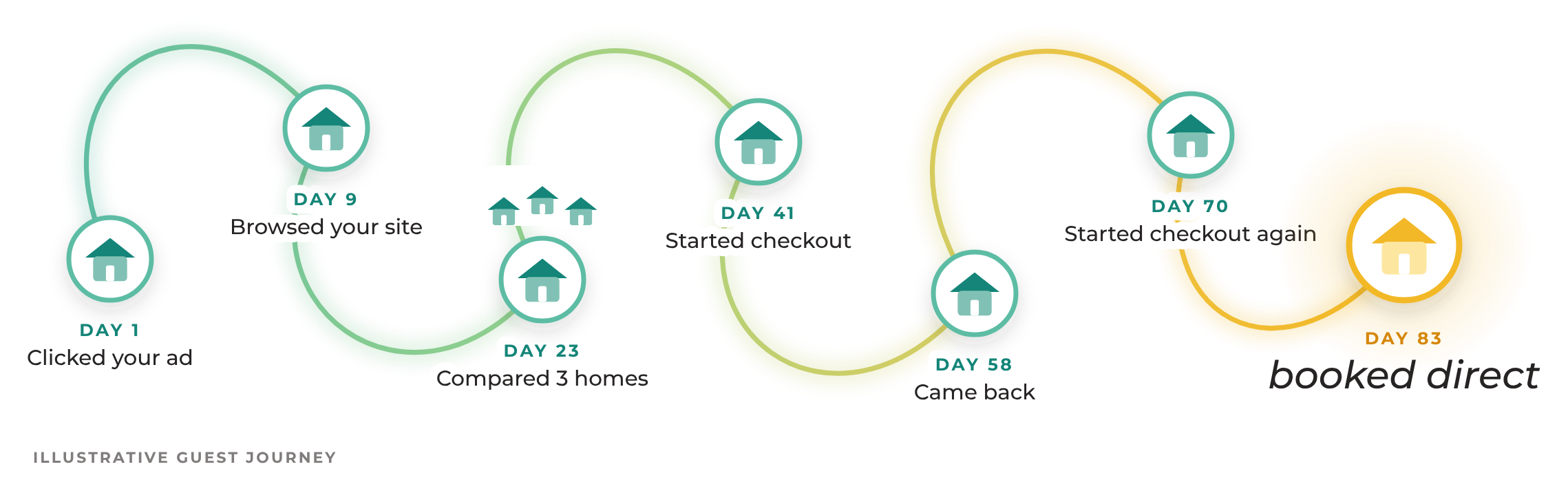
The OTAs don’t win on magic. They win on a few things any good operator can do: they show up early, they make booking easy, they build trust and they remember the guest. Here’s how to play the same game on your own turf.
None of this means leaving the OTAs. Keep them for reach. Just stop letting them be the only place a guest can find you. Do these well and every direct booking is one the OTAs didn’t get to take a cut of.
This is the work BookingsCloud does: connecting marketing and booking performance in one system, so you can see which plays turn into direct bookings.
Airbnb and Vrbo are for-profit businesses, and they’ll keep adjusting fees, rules and rankings to serve their own growth. The past year is a good preview:
The question isn’t whether the next change is coming. It’s how much it costs you when it does. A manager who sources most demand from marketplaces absorbs every change as a margin hit or a pricing decision. A manager who has built direct demand has a second source of bookings that doesn’t run on the marketplace’s terms, so the next change feels more like a speed bump than a cliff.
This isn’t about leaving Airbnb or Vrbo. You’ll keep paying for demand. What changes is how: part of your spend shifts from commission on marketplace bookings to building brand-new direct demand that you own. Even a modest shift matters, because every booking that lands on your own site skips the commission and adds a guest relationship that belongs to you.
Owners are better informed than they were a few years ago, and they expect their manager to innovate. When an OTA changes the rules, they notice which managers are rattled and which are steady.
Bottom line: The OTAs will keep changing. The managers who barely feel it will be the ones who built demand they own.
KeyData surveyed U.S. property managers about the year ahead. Here’s the short, spreadsheet-free version.
Source: ShortTermRentalz coverage of KeyData’s 2027 Vacation Rental Industry Outlook, plus the report itself.
Airbnb’s house rule update is another reminder that property managers don’t have full control over the platforms they depend on. Here’s where we’d start:
The bigger picture: Airbnb can change its policies, fees and algorithms whenever it updates its platform. Your direct booking strategy shouldn’t depend entirely on those decisions.
Airbnb charges most hosts a single host-only fee of 15.5% (14% to 16% for the rest) and no guest service fee. Vrbo moved hosts to a 12% commission on bookings made from October 29, 2026, and the traveler service fee remains in most cases.
For reservations booked on or after November 20, 2026, hosts generally can’t require a separate rental agreement or an extra security deposit, can’t require checkout chores normally done by cleaners, and face new limits on collecting guest information. House rules must be listed before the guest books.
It protects your payout on each booking, but it raises the price guests see for the same home and does nothing to give you the guest relationship. On Airbnb, a $100 night has to move to about $115 to keep the same payout, while the same stay booked direct can stay at $100.
No. Airbnb and Vrbo still bring guests, and most managers keep using them. The goal is to shift part of your bookings to direct, so you own more of your demand and feel each OTA change less. Expect more changes from the platforms, since both are for-profit businesses.
By doing what the OTAs do well, on your own website. Show up early while travelers are still dreaming, be findable in Google and AI search, make booking easy and trustworthy, give guests a reason to book direct, remember your guests through consent-based channels, and track which marketing turns into bookings. You don’t have to leave Airbnb or Vrbo to do it.
Owners expect their manager to innovate and to protect their income from platform changes. A manager with a growing direct channel can show a source of demand they control, which supports keeping current owners and winning new ones. It doesn’t require leaving the OTAs: even a smaller share of direct bookings reduces exposure to each change.
Publish direct-booking pages that answer the questions travelers actually ask: what the home is like, who it suits, what is nearby, what is included and why booking direct costs less. Use clear headings and plain facts, keep details consistent across your site and listings, and make sure search engines can index your pages.
BookingsCloud is a vacation rental marketing platform that helps property managers drive brand-new direct bookings and reduce their dependence on online travel agencies. It automates property-specific demand, helping each of your homes attract new direct guests. It connects marketing and booking performance in one system, so you can see which marketing produces bookings on your own website. It also shows transparent attribution and guest journeys inside the platform, so if you’ve ever wondered what’s happening on your website and where you’re losing demand to the OTAs, this is the tool for you.
BookingsCloud helps vacation rental operators connect marketing and booking performance in one system. Request a demo to see how it works for your portfolio.

When bookings slow down, most operators drop their rates. It feels logical, but it’s actually just a symptom of low demand, not a strategy for...

For years, vacation rental managers have treated Airbnb commissions like utilities: fixed costs you can't control. But this fall, at conferences...

Short-term rental (STR) leaders have been talking about the need to increase direct bookings for nearly a decade, but nobody's cracked the code. ...